By Dina Railean, Honorary Consul of the Republic of Moldova in Manchester
How Trade Missions Turn Contacts Into Business
A trade mission should never be judged only by the number of meetings held. The real test begins when delegates return home. Did they maintain the relationships they formed? Have early conversations developed into credible opportunities? Can the knowledge gained help them make better commercial decisions?
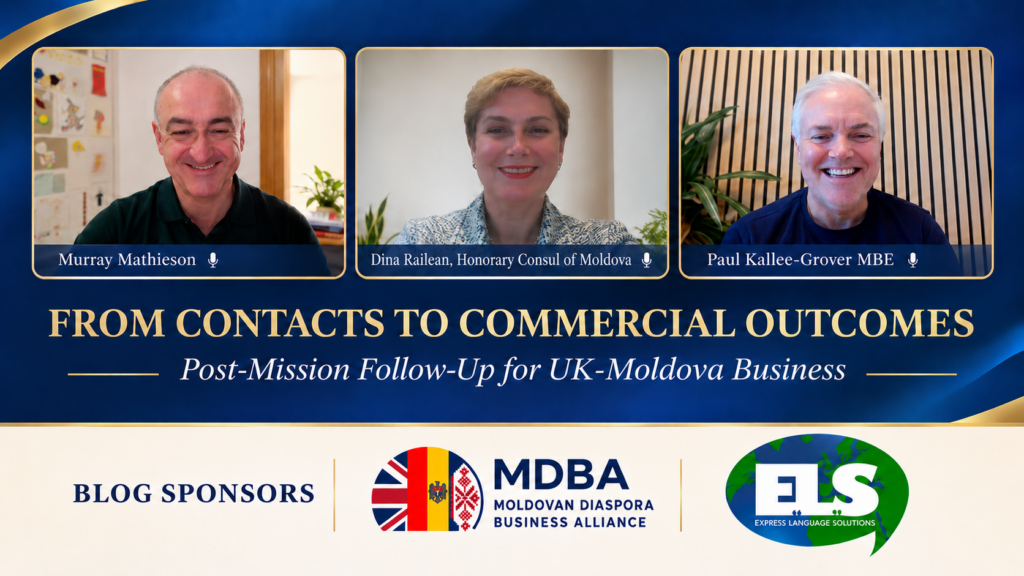
On 26 October 2026, Paul Kallee-Grover MBE and I held an online follow-up meeting with Murray Mathieson, Director of Positively Legal Ltd. Murray joined the First UK Business-Led Mission to Moldova, which took place from 27 September to 2 October 2026 and coincided with Moldova Business Week.
Our meeting focused on converting contacts into outcomes.
A mission should begin a commercial journey
Moldovan Diaspora Business Alliance Ltd and Ki Partnerships Ltd organised the mission in association with Express Language Solutions Ltd.
Paul joined the programme as a Department for Business, Innovation and Trade Export Champion, Managing Director of Ki Partnerships Ltd and mission co-leader. Together, we designed the mission to provide more than attendance at a major business event.
Delegates received:
- Pre-mission strategy discussions
- Language and business-culture guidance
- Access to Moldova Business Week
- Introductions to relevant decision-makers
- Business and institutional visits
- Networking opportunities
- Practical support during the programme
- Individual post-mission follow-up
That final stage matters.
Without structured follow-up, promising contacts can become names in a telephone or connections on LinkedIn. Therefore, every delegate received a Feedback Questionnaire and an invitation to discuss the next steps.
Listening before offering support
During our meeting, Murray, Paul and I reviewed his completed questionnaire. The discussion helped us understand which parts of the programme created value for his business. It also allowed us to identify where our support might help in future.
Murray gained:
- New contacts and relationships
- A stronger understanding of Moldova
- Potential partners and customer prospects
- Greater confidence in the market
- A number of early commercial opportunities
- Useful connections with fellow delegates
Follow-up discussions are taking place.
Murray is now exploring a number of opportunities in Chisinau. He is also considering possible collaboration with another mission delegate.
Commercial discussions remain confidential. That confidentiality deserves respect.
A trade mission should create trusted access without placing pressure on delegates to disclose sensitive negotiations before they mature. Paul and I remain available to support Murray. whenever our input becomes useful.
This approach keeps responsibility with the business while preserving access to the mission network.
Delegate collaboration creates unexpected value
Many businesses join trade missions to meet overseas buyers, suppliers or institutional partners. Yet some of the most useful opportunities can develop within the delegation itself. Participants spend several days travelling, attending events and solving practical challenges together. They learn about one another’s expertise. Trust develops through shared experience.
As a result, one delegate may become another delegate’s client, adviser, supplier, referral partner or collaborator.
This type of value rarely appears in the formal programme. Nevertheless, mission leaders can encourage it by selecting participants carefully and creating opportunities for the group to build relationships.
Our delegation included businesses from professional services, international trade, property, language services and technology. The range of expertise supported cross-sector conversations. At the same time, the group remained small enough for meaningful relationships to form.
Murray’s potential collaboration with another delegate shows why the quality of a delegation matters as much as its size.
Trusted access reduces the distance between markets
Entering a new market can feel difficult, especially for a small or medium-sized business. Public information rarely answers every practical question.
A company still needs to understand:
- Who makes decisions
- Which organisations have credibility
- How business relationships develop
- What local clients expect
- Where professional advice is required
- How regulation may change
- Which opportunities merit further work
- When to proceed and when to pause
A well-designed mission reduces this information gap. It cannot remove commercial risk. Nor can mission leaders guarantee contracts.
However, trusted introductions and local knowledge can help a business ask better questions and make more informed decisions.
For Murray, access to senior law-firm leaders was especially relevant. Business networking also created opportunities that he would not necessarily have identified from the United Kingdom.
Moldova Business Week strengthened this access. The 2026 programme recorded around 1,800 unique participants from more than 50 countries, 35 events and over 250 new contacts made by Invest Moldova with potential investors and commercial partners. Its three central themes were European economic integration, sector investment and the export of services.
Those figures demonstrate scale. Still, delegates create value only when they identify the contacts that matter to their own objectives.
Follow-up turns activity into evidence
Moldova Business Week itself recognised that the next task involves converting contacts and discussions into partnerships, investments and commercial relationships.
The same principle applies to our delegation. Mission outcomes should receive measurement over several months, not immediately after the return flight.
Useful indicators include:
- Follow-up meetings arranged
- Proposals or information exchanged
- Partnerships under discussion
- Return visits planned
- Workshops or pilot projects developed
- Referrals between delegates
- Market-entry decisions
- Contracts secured
- Investment committed
- Opportunities reviewed and rejected for sound reasons
Not every introduction will produce business. That does not make the mission unsuccessful.
A company may discover that the market requires more preparation. Another delegate may decide to enter through a partner rather than open an office. Sometimes the most valuable outcome involves avoiding a poorly timed investment.
Good economic diplomacy supports informed commercial decisions. It does not manufacture success stories.
Why Moldova merits attention
Moldova is advancing through the European Union accession process.
In October 2026, the EU and Moldova opened negotiations covering the internal market, competitiveness and inclusive growth. These areas include company law, financial services, competition, taxation, customs, digital transformation, education, research and industrial policy.
Such reforms matter to British businesses.
Closer alignment with European standards may affect:
- The movement of goods, services and capital
- Business regulation
- Consumer protection
- Digital services
- Professional standards
- Customs procedures
- Access to finance
- Investment conditions
European integration does not guarantee a simple market-entry journey. However, it creates a changing commercial environment that businesses should understand early.
The United Kingdom and Moldova also operate under a Strategic Partnership, Trade and Cooperation Agreement. The two countries continued their formal trade dialogue in London in April 2026.
This framework provides a foundation. Businesses must still turn it into activity.
Opportunities beyond one sector
The mission’s value extends beyond professional services.
Universities can support:
- Executive education
- Professional training
- Research partnerships
- Student and academic exchanges
- Innovation and knowledge transfer
Airports can strengthen business travel, tourism, diaspora connections and investor access. Meanwhile, logistics companies can examine Moldova’s growing role in regional supply chains. Insurers, lawyers and financial advisers can help investors assess risk and structure projects. Property, infrastructure, technology and professional-services businesses may also explore Moldova’s potential role in the reconstruction of Ukraine.
Moldova may offer regional knowledge, local partners and an operational base for some companies preparing for future opportunities. However, establishing an office in Moldova cannot guarantee access to reconstruction contracts.
Businesses must develop suitable expertise, understand procurement requirements and assess commercial risk. Preparation must come before expansion.
Early registration improves mission value
Future delegates can also learn from the 2026 experience.
A bespoke programme requires time. Mission leaders need to understand each company’s objectives, research suitable contacts and arrange relevant meetings.
Several 2026 delegates joined after the published registration deadline. As a result, it was not possible to circulate complete delegate information far in advance.
Future businesses should register early. Earlier commitment allows organisers to:
- Build stronger delegate profiles
- Identify possible collaborations
- Arrange targeted introductions
- Develop sector-specific programmes
- Provide better market preparation
- Coordinate travel and practical support
- Increase the time available for outreach
A deadline should therefore serve a commercial purpose rather than act as an administrative formality.
The mission continues
Murray’s follow-up meeting demonstrates the model we want to develop.
The mission created access. Moldova Business Week provided market exposure. Delegates formed relationships. Now individual businesses must decide which opportunities deserve further work.
Paul and I will remain available when our knowledge, networks or introductions can add value.
The wider lesson remains simple. A successful mission does not end at the airport. It continues through every follow-up call, proposal, introduction, return visit and informed commercial decision that follows.
Businesses interested in future UK-Moldova Business Missions can contact me directly at RM.Honorary.Consul@gmail.com.
Organisations may also contact the Honorary Consulate to:
- Discuss Moldova’s business environment
- Request information about future commercial events
- Propose academic or institutional partnerships
- Explore relevant business introductions
- Register interest in the proposed 2027 mission
This article continues my Building Bridges series on economic and investment diplomacy.
Follow my work through:
This article was sponsored by Express Language Solutions Ltd and Moldovan Diaspora Business Alliance Ltd.
I thank ELS and MDBA for their continued support of UK-Moldova trade, economic diplomacy and international business engagement.
Businesses, universities and professional organisations interested in sponsoring future articles, newsletters or bilateral initiatives can contact RM.Honorary.Consul@gmail.com.
About the Author
Dina Railean is the Chief Executive Officer of Express Language Solutions Ltd, Salford President of the Greater Manchester Chamber of Commerce, Honorary Consul of the Republic of Moldova in Manchester, Chair and Chief Executive Officer of the Moldovan Diaspora Business Alliance, and a Council Member of The Insurance Institute of Manchester.
Through her work across business, diplomacy and professional leadership, she writes about international trade, foreign direct investment, cross-cultural communication, leadership and the strategies that help organisations build trust and succeed across borders.