How Moldova’s Diaspora Can Drive Trade and Growth
By Dina Railean, Honorary Consul of the Republic of Moldova in Manchester
A country’s diaspora should never sit at the edge of its economic strategy.
It can stand at its centre.
Diaspora members understand more than two languages. They understand two business cultures, two sets of expectations and two ways of building trust.
That knowledge can reduce the distance between markets.
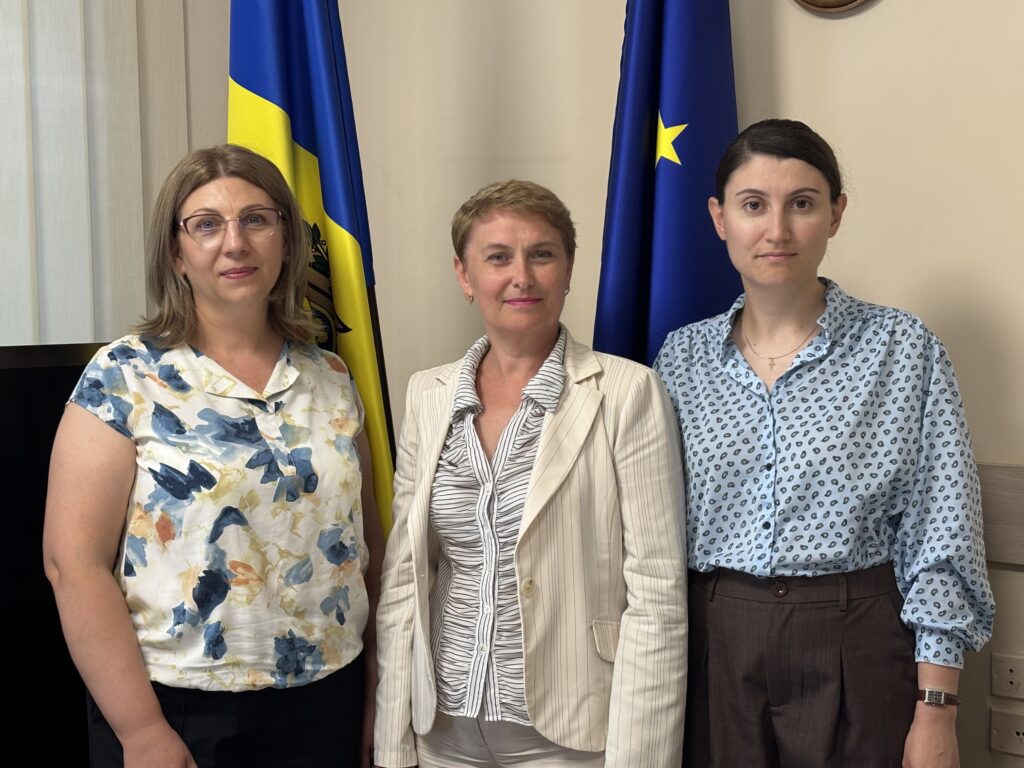
On 19 August 2026, I met Violina Donu and Oxana Rosca from the Office for Diaspora Relations in Chisinau.
Our meeting took place at its offices in the Government Building.
We discussed how the Honorary Consulate of the Republic of Moldova in Manchester and the Office for Diaspora Relations could work together.
Importantly, our conversation covered both community ties and Moldova’s wider economic future.
A practical partnership for the North West
The North West of England forms my consular district.
Thousands of people across the region maintain personal, cultural and professional connections with Moldova.
Yet those relationships can produce even greater value when institutions support them in a structured way.
During our meeting, we identified several areas for continued dialogue:
- Cultural and educational programmes
- Romanian-language preservation
- Diaspora events in the North West
- Consular outreach
- Tourism promotion
- Direct air connectivity
- Charity and social projects
We agreed to remain in contact and share updates on future developments.
That continued dialogue matters. Institutional trust grows through regular communication, clear responsibilities and realistic projects.
Diaspora policy can support economic policy
People often view diaspora engagement mainly through culture, language and community events.
These areas remain essential.
Families need opportunities to pass the Romanian language, Moldovan traditions and a sense of belonging to younger generations.
However, Moldova should also treat its diaspora as economic infrastructure.
Professionals living abroad can:
- Introduce credible business partners
- Connect Moldovan exporters with overseas buyers
- Explain commercial expectations in both markets
- Promote Moldova as a visitor and investment destination
- Share specialist knowledge
- Support academic partnerships
- Identify barriers to trade
- Build confidence among potential investors
Consequently, diaspora engagement can strengthen bilateral trade without losing its cultural purpose.
Community identity and economic development do not compete with each other.
Instead, each can reinforce the other.
The First UK Business-Led Trade Mission to Moldova
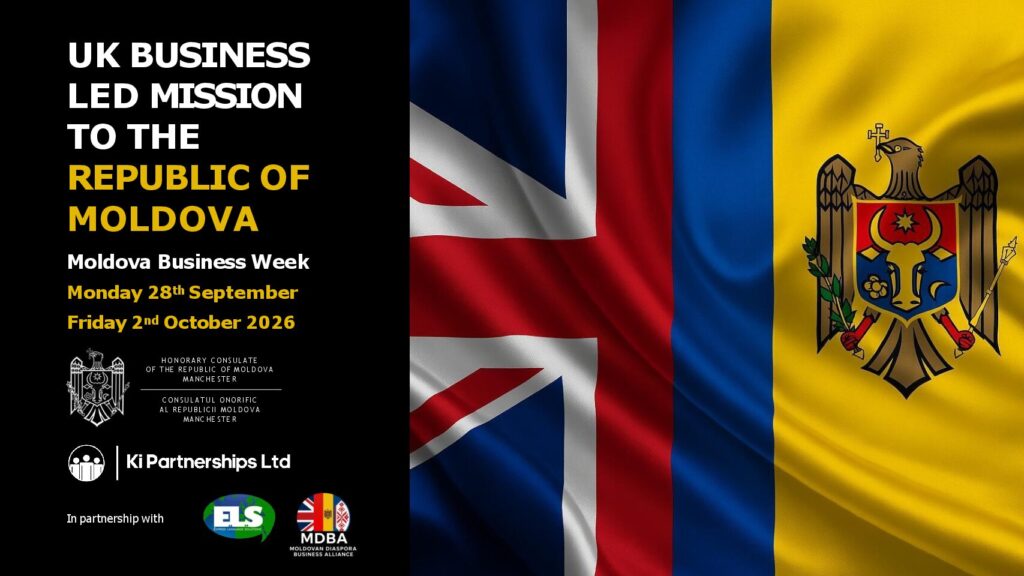
I also informed the Office for Diaspora Relations about the First UK Business-Led Trade Mission to Moldova.
Paul Kallee-Grover MBE and I will lead the mission from 27 September to 2 October 2026.
Paul serves as a Department for Business and Trade Export Champion and Managing Director of Ki Partnerships Ltd.
Our delegation will arrive on Sunday, 27 September. The programme will then coincide with Moldova Business Week from 28 September to 2 October.
Moldova Business Week will bring together investors, exporters, companies, financial institutions and public decision-makers. Its priorities include European economic integration, investment attraction and export growth. Delegates can also access sector forums, business meetings, roundtables and regional visits. Invest Moldova sets out the official programme and priorities.
Three places remain available.
The final deadline for expressions of interest is 21 September 2026.
Current delegates represent:
- Legal services
- Interpreting and translation services
- Bilateral trade
- Business consultancy
- Real estate
- Information technology
Nevertheless, the mission welcomes interest from every sector.
A mission designed around each company
A trade mission should do more than place delegates in a conference hall.
Every company brings different objectives, risks and questions.
Therefore, participants will complete a pre-mission needs assessment or strategy call.
Mission leaders will use that information to shape a more relevant programme.
Delegates will receive:
- A language and cultural etiquette briefing
- Access to Moldova Business Week
- Sector-specific introductions
- Meetings with relevant institutions and businesses
- Practical market insight
- Support during the visit
- A one-to-one post-mission debrief
- Help identifying realistic next steps
This approach allows businesses to explore the wider policy and investment environment while pursuing individual opportunities.
Afterwards, follow-up support will help delegates turn introductions into action.
Why UK businesses should examine Moldova now
Moldova offers opportunities in its domestic economy.
More importantly, its European path is changing the strategic context.
The country gained EU candidate status in June 2022. Formal accession negotiations opened in June 2024. During 2026, negotiations advanced through the opening of the fundamentals cluster and the external-relations cluster. The Council of the European Union provides the current accession position.
For UK companies, closer alignment with European standards may create a more familiar and predictable operating environment.
Yet accession will remain a demanding, merit-based process.
Businesses must still assess regulation, contracts, taxation, finance, governance and local partnerships carefully.
That need for careful preparation strengthens the case for visiting the market directly.
Opportunities across the North West
Moldova’s development can create openings for many parts of the North West economy.
Lawyers, insurers, accountants and finance professionals can help companies manage risk and structure investment.
Universities can build research, student exchange and skills partnerships.
Airports can assess demand created by diaspora travel, tourism, education and business links.
Meanwhile, logistics companies can explore routes connecting the United Kingdom, Moldova, Romania and Ukraine.
Direct flights would make these relationships easier to build.
The Liverpool-Chisinau and Manchester-Chisinau services previously demonstrated demand, although both routes now remain suspended.
Restoring sustainable direct air connectivity should remain a long-term commercial objective.
Moldova and Ukraine’s reconstruction
Geography also gives Moldova a potential role in Ukraine’s reconstruction.
UK companies should avoid treating that prospect as a quick or guaranteed commercial opportunity.
Preparation will require regional knowledge, suitable partners, strong compliance and a clear understanding of future procurement.
Even so, businesses interested in reconstruction should examine Moldova now as a possible operational, logistics and partnership base.
Invest Moldova describes the country as a potential “gateway economy” that can support logistics, investment and cross-border cooperation. It also identifies the neighbouring Ukrainian regions of Odesa, Vinnytsia and Chernivtsi as part of a natural corridor linking Ukraine with Moldova, Romania and the European Union. Its analysis explains Moldova’s possible reconstruction role.
A company that establishes relationships early can acquire regional knowledge before major opportunities emerge.
That does not mean every business should open a Moldovan office immediately.
Rather, each company should test the case, understand tender requirements and decide whether a local presence would strengthen its position.
From community connections to measurable results
Diaspora diplomacy works best when it connects identity with opportunity.
Cultural events preserve belonging.
Romanian-language learning connects younger generations with their heritage.
Tourism introduces new visitors to Moldova.
Academic cooperation develops knowledge.
Business relationships create trade, investment and employment.
Accordingly, the Honorary Consulate will seek practical ways to connect Moldovan communities, British institutions and commercial partners across the North West.
My meeting with the Office for Diaspora Relations marked another step in that work.
Now we must turn dialogue into sustained cooperation.
Join the trade mission
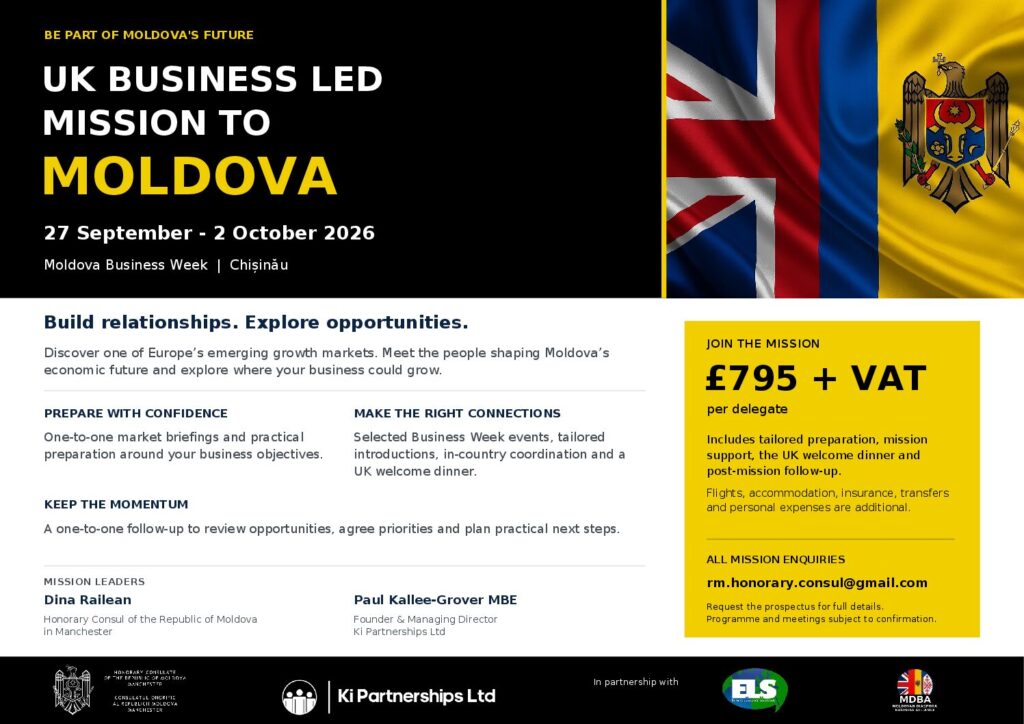
Only three places remain on the First UK Business-Led Trade Mission to Moldova.
Businesses interested in joining must submit an expression of interest by the final deadline of 21 September 2026.
Please contact me directly at RM.Honorary.Consul@gmail.com.
Further details appear on the official trade mission page.
Readers can follow my diplomatic, community and economic engagement through:
This article continues my thought leadership series on economic diplomacy and investment diplomacy.

Express Language Solutions Ltd and Moldovan Diaspora Business Alliance Ltd sponsored this article.
I thank ELS and MDBA for their continued support for diaspora engagement, bilateral trade and investment diplomacy.
Organisations interested in sponsoring future articles or UK-Moldova initiatives can contact me privately at RM.Honorary.Consul@gmail.com.
About the Author
Dina Railean is the Chief Executive Officer of Express Language Solutions Ltd, Salford President of the Greater Manchester Chamber of Commerce, Honorary Consul of the Republic of Moldova in Manchester, Chair and Chief Executive Officer of the Moldovan Diaspora Business Alliance, and a Council Member of The Insurance Institute of Manchester.
Through her work across business, diplomacy and professional leadership, she writes about international trade, foreign direct investment, cross-cultural communication, leadership and the strategies that help organisations build trust and succeed across borders.