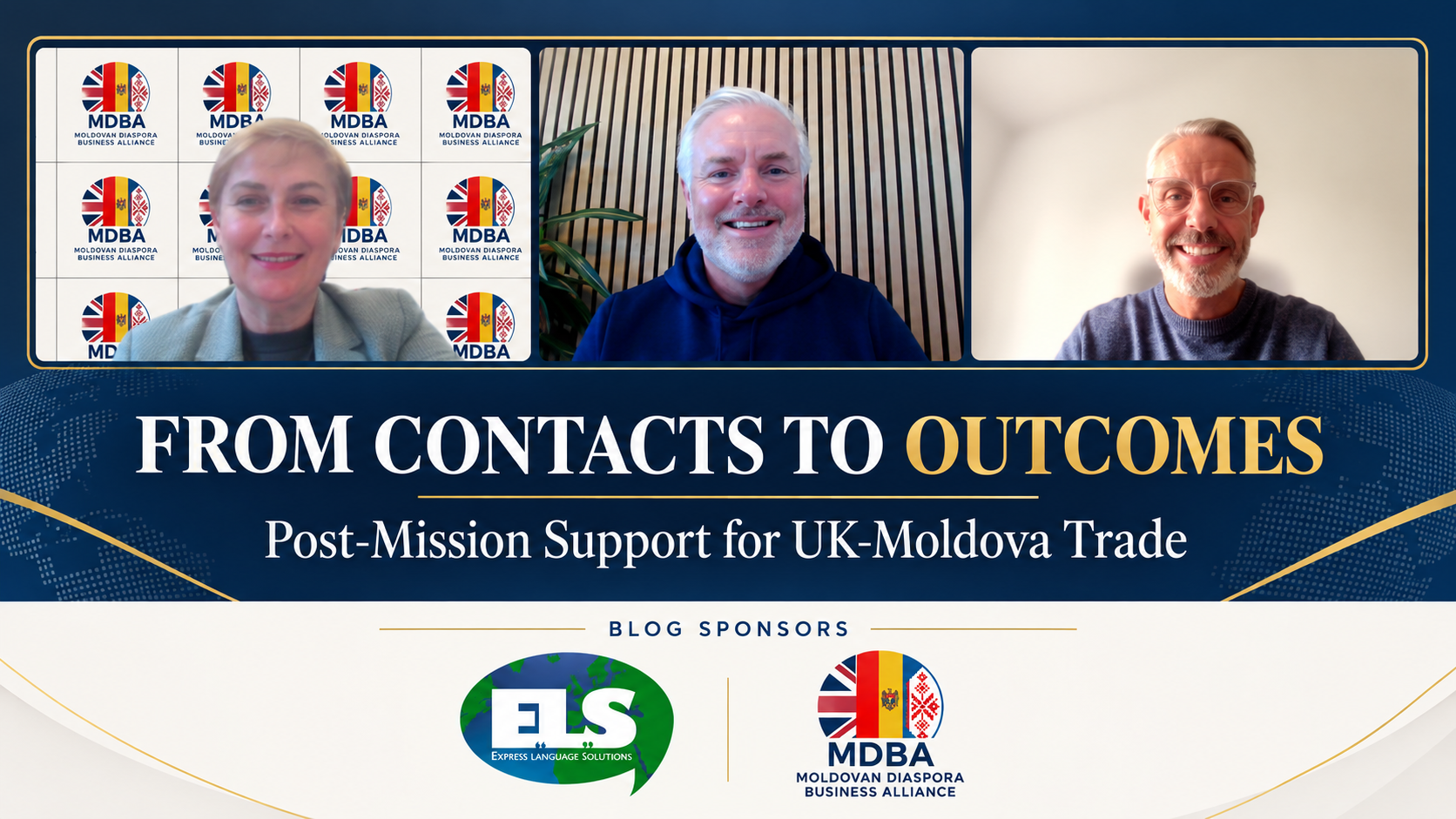
How Trade Missions Turn Contacts Into Growth
A business mission does not end when the delegates fly home. That moment marks the start of the most important stage.
Introductions must become conversations. Conversations need clear next steps. Promising contacts require patient follow-up. Without that work, even an excellent programme can become little more than a collection of business cards and photographs.
On 21 October 2026, I joined Paul Kallee-Grover MBE for an online follow-up meeting with property developer Kerry Tomlinson. Kerry attended Moldova Business Week from 28 to 30 September as part of the First UK Business-Led Mission to Moldova. Our discussion focused on a simple question: how can we convert the knowledge, contacts and commercial leads gained in Moldova into practical outcomes?
From introduction to implementation
During the meeting, we reviewed Kerry’s Feedback Questionnaire. This process allowed us to understand which parts of the mission created the greatest value. It also helped us identify where further support could maintain momentum.
Kerry gained a stronger understanding of Moldova and developed new commercial leads during the visit. Exploratory discussions also took place around a potential project. However, an early conversation does not constitute a commercial result.
Every opportunity requires further research, suitable partners, a realistic timetable and a clear understanding of local conditions. Therefore, Paul and I are preparing an initial support proposal for Kerry to consider.
The package may include:
- Introductions to relevant Moldovan businesses
- Practical market-entry planning
- Language and cultural support
- Guidance on maintaining promising contacts
- Help in identifying sensible next steps
- Support for future visits and meetings
This approach protects the value created during the mission. More importantly, it places the needs of the individual business at the centre of the process.
Why tailored follow-up matters
No two companies enter a market in the same way. A property developer will ask different questions from a technology company, law firm, logistics provider or university. Investment priorities, funding structures, planning requirements and risk profiles will also vary. Consequently, generic follow-up rarely delivers enough value.
A strong post-mission framework should help each delegate:
- Review the original commercial objectives
- Assess the introductions made
- Prioritise the strongest opportunities
- Identify gaps in knowledge
- Agree practical next steps
- Set timescales for further action
- Measure progress over the following months
The mission leaders must not make decisions for the business. Instead, we can provide knowledge, trusted connections and a structured route forward.
That distinction matters.
Companies remain responsible for commercial due diligence, professional advice and investment decisions. Yet credible local support can help them ask better questions and avoid preventable mistakes.
Moldova’s changing commercial context
Moldova Business Week 2026 brought investors, exporters, financial institutions, public bodies and international companies together.
The programme focused on European economic integration, investment attraction and export growth. It also presented Moldova’s economic offer to international businesses.
Meanwhile, Moldova continues to advance through the European Union accession process. On 13 October 2026, the EU and Moldova opened negotiations on the internal market and on competitiveness and inclusive growth. These areas cover matters such as goods, services, capital, company law, financial services, digital transformation, taxation, research, education and customs.
For British businesses, that process deserves close attention.
Regulatory alignment will not remove every difficulty. Nor will it guarantee that an investment succeeds.
However, closer alignment with European standards may influence:
- Market access
- Investment conditions
- Company regulation
- Consumer protection
- Professional services
- Digital development
- Infrastructure
- Procurement
- Cross-border supply chains
Early engagement gives companies time to understand those changes before deciding whether Moldova fits their strategy.
A working foundation for UK-Moldova trade
British and Moldovan companies already operate within an established bilateral framework. The UK-Moldova Strategic Partnership, Trade and Cooperation Agreement covers trade in goods and services, intellectual property, public procurement and other areas of economic cooperation. Official talks held in April 2026 also recognised stable bilateral trade, growth following liberalisation measures and greater diversification in Moldovan exports to the UK. Nevertheless, agreements alone do not create commercial activity.
Businesses create trade when they identify demand, understand risk, meet credible partners and keep working after the first introduction. For this reason, the First UK Business-Led Mission to Moldova placed follow-up at the heart of its model.
Moldovan Diaspora Business Alliance Ltd and Ki Partnerships Ltd organised the mission in association with Express Language Solutions Ltd.
Paul brought his experience as a Department for Business and Trade Export Champion, Managing Director of Ki Partnerships Ltd and mission co-leader.
My role combined economic diplomacy, diaspora knowledge, language expertise and practical support through the Honorary Consulate of the Republic of Moldova in Manchester.
Together, we aim to help delegates convert contacts into informed commercial decisions.
The wider value for the North West
A successful market-entry journey rarely involves one company alone. Professional advisers, universities, investors, airports and logistics providers can all contribute.
For example:
- Lawyers can explain contracts, regulation and property structures
- Insurers can assess political, construction and operational risks
- Accountants can support tax and financial planning
- Universities can develop research and knowledge partnerships
- Investors can examine viable projects and funding needs
- Airports can support business, tourism and diaspora connectivity
- Logistics companies can assess regional supply chains
- Cultural and language specialists can reduce communication risks
Direct relationships also strengthen cultural diplomacy. Familiarity builds trust. Trust makes honest commercial conversations easier. Those conversations can then support trade, investment, education and tourism.
Thus, local representation matters.
The Honorary Consulate can act as an accessible point of contact for North West organisations seeking to understand Moldova. It can also help Moldovan institutions and businesses engage with this region.
Preparing carefully for regional opportunities
Moldova’s location also attracts interest from companies considering future work connected with Ukraine’s reconstruction. British businesses should assess whether Moldova could provide useful regional knowledge, partnerships, skills or an operational base.
Property development, construction, logistics, professional services, insurance, technology and infrastructure may all contribute to long-term regional recovery. Still, companies must approach this opportunity carefully.
Opening an office in Moldova cannot guarantee access to contracts. Relationships alone cannot replace procurement readiness or technical capability.
However, early preparation may help a business:
- Develop regional knowledge
- Understand future procurement requirements
- Identify suitable partners
- Build relevant experience
- Assess operational risks
- Strengthen tender readiness
Commercial patience will matter as much as ambition.
The mission continues after the mission
Our meeting with Kerry reflects a wider commitment to every delegate.
Feedback should lead to action. Support should reflect genuine business needs. Progress should receive regular review.
Moreover, future missions should measure more than attendance.
A credible assessment framework should track:
- Introductions that progress to further meetings
- Commercial proposals
- Pilot projects
- Partnership agreements
- Investments
- Return visits
- Offices or local representation established
- Academic and institutional collaborations
- Contracts secured over time
Not every conversation will produce a deal. Even so, a business that reaches a well-informed decision has gained value. Sometimes the correct outcome involves entering the market gradually. On other occasions, a company may decide to wait or pursue a different route.
Sound economic diplomacy supports informed decisions rather than predetermined conclusions.
Register for future UK-Moldova missions
The First UK Business-Led Mission created new relationships and a stronger understanding of Moldova’s commercial environment. Now the work turns towards outcomes.
Businesses interested in joining a future UK-Moldova Business Mission can register their interest by contacting me directly at RM.Honorary.Consul@gmail.com.
Companies may also contact the Honorary Consulate to:
- Request updates about Moldovan business events
- Discuss potential market opportunities
- Explore future trade missions
- Propose academic or institutional partnerships
- Seek relevant introductions
- Begin an informed conversation about Moldova
The question is not simply whether a company attends a mission.
What matters is what that company does with the opportunity afterwards.
This article continues my Building Bridges series on economic and investment diplomacy.
Follow my work through:
This article was sponsored by Express Language Solutions Ltd and Moldovan Diaspora Business Alliance Ltd.
I thank ELS and MDBA for their continued support of economic diplomacy, international trade and stronger UK-Moldova relations.
Organisations interested in sponsoring future articles, missions or bilateral initiatives can contact RM.Honorary.Consul@gmail.com.
About the Author
Dina Railean is the Chief Executive Officer of Express Language Solutions Ltd, Salford President of the Greater Manchester Chamber of Commerce, Honorary Consul of the Republic of Moldova in Manchester, Chair and Chief Executive Officer of the Moldovan Diaspora Business Alliance, and a Council Member of The Insurance Institute of Manchester.
Through her work across business, diplomacy and professional leadership, she writes about international trade, foreign direct investment, cross-cultural communication, leadership and the strategies that help organisations build trust and succeed across borders.